/197/1/logo.png)
Hybrid Vs Fully Electric Cars: The Complete Guide to Making the Right Choice
How To Find The Right Type of Electric Car
Petrol prices have reached an all-time high, and more motorists are considering the switch to an electric vehicle. Moreover, the Zero Emission Vehicle (ZEV) mandate requiring a 100% sale of electric cars by 2030 makes the switch to EVs not a matter of ‘if’ but ‘when’. With so many options on the market, each with different specifications, it is hard to find the right car for your unique needs. The question that is probably on your mind is: should I go for a hybrid or a fully electric car?
As one of the few leading EV car finance brokers, at Octane Finance, we’re here to guide you through your options clearly and simply. From picking the right type of electric vehicle to securing the right finance, this guide covers it all. Let’s get started.
Understanding the Types of Electrified Vehicles
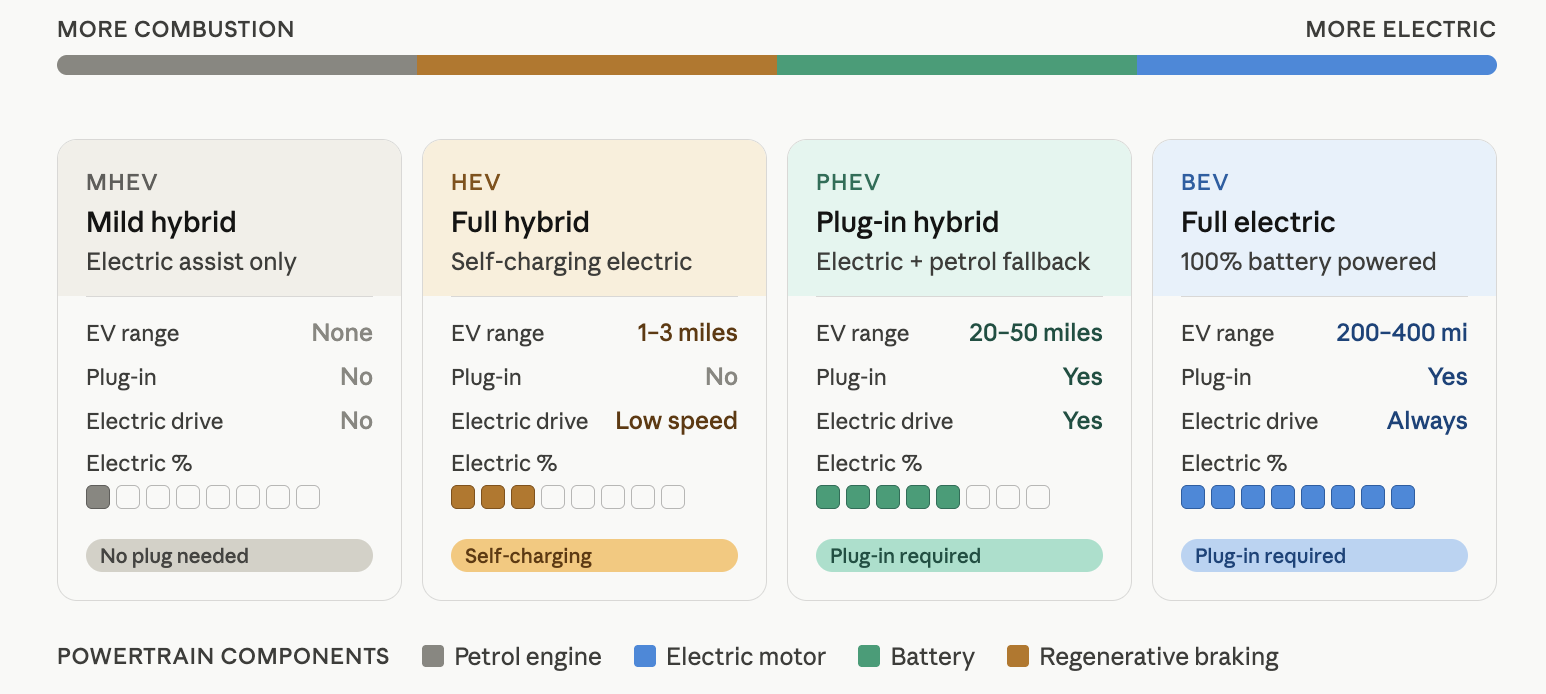
Understanding electrified vehicles is simple: think of it as a spectrum. On one side, you have hybrid models that fall back on petrol, and on the other, you have fully electric vehicles. Where you land on the spectrum depends on your lifestyle. Let’s take a look at some of the types of electric cars that are on the market.
Mild Hybrid (MHEV)
Mild Hybrid cars are at the very beginning of the spectrum. They rely on petrol or diesel, but they use a small electric motor that assists with acceleration and allows the engine to shut off sooner when braking or coasting. It improves fuel efficiency and slightly reduces fuel emissions.
Full Hybrid (HEV)
Full Hybrid cars are also known as self-charging electric cars because they have a self-charging electric motor that automatically recharges during deceleration and braking. This allows the car to use electric power, petrol or both simultaneously, depending on the circumstances.
Plug-in Hybrid (PHEV)
Plug-in Hybrid cars have a larger rechargeable battery and an electric motor that allows them to drive on electric power between 20-50 miles before falling back on the petrol/diesel engine. They need to be plugged in to be recharged.
Full Electric (BEV)
Fully electric cars don’t have a petrol or diesel engine, and they operate solely on an electric motor, producing zero tailpipe emissions. They need to be plugged in to recharge their batteries and can usually drive between 200 and 400 miles before needing to be recharged.
Deciding what electric car will match your lifestyle depends on your usage, but most people who make the switch to electric will usually go for a plug-in hybrid (PHEV) or a fully electric (BEV). That is where the choice usually lies, especially with the ZEV mandate aiming to 100% electric car sales by 2030. We’re gonna take a closer look at PHEVs and BEVs so that you can get a better idea of which one makes the most sense for your lifestyle.
Plug-in Hybrid Cars: What You Need to Know
As we have seen, PHEVs are cars that have a battery and an electric motor, and a petrol or diesel engine. Most people who want to move to electric vehicles tend to choose between PHEVs and BEVs. This is because PHEVs benefit more from the electric motor than other hybrids, making PHEVs the fastest-growing segment in the UK, with a 34.7% increase in 2025 compared to 2024.
If you are considering a PHEV, there are a few key things you need to know. Let’s start with the positives.
- They can fall back on a petrol/diesel engine, which, in turn, reassures motorists about range anxiety.
- You get real-world fuel savings when driving short distances with a daily charge.
- Most PHEVs are ULEZ-compliant, making them a great choice if you commute to London or need to drive in CAZ areas.
As always, there are also some downsides to PHEVs.
- They have an electric range of 20-50 miles, making them a good choice for short commutes but not for mid-distances.
- They require regular charging to get the maximum benefits of the technology. Home charging is recommended to keep costs down. Driving a PHEV without using the electric component makes it less efficient and less cost-effective.
- Driving them with a depleted battery makes them less efficient and more expensive, as they will be driving on a smaller engine and carrying a heavy battery.
Plug-in Hybrids are a great start if you are planning to switch to an electric vehicle, but still experience some electric car range anxiety. The petrol/diesel engine fallback gives you the freedom to travel longer distances without having to plan EV charging stops along the way. At the same time, if you plan on driving long distances often, PHEVs will become less efficient and more expensive.
Overall, if you use your car mainly for day-to-day use or for short commutes under 50 miles, you will benefit from PHEV technology. You will also have a lower running cost if you install a home charging point.
Fully Electric Cars: What You Need to Know
Fully electric cars (BEVs) are currently being promoted by the government and have seen a massive uptake in recent years. With fuel prices being so high, the interest in the EV market has increased exponentially.
BEVs are becoming increasingly popular, accounting for 23.4% of market share in 2025. If you’ve always driven a petrol or diesel car, the idea of going fully electric can be pretty daunting, but there are some incredible benefits to making the switch. Let’s take a look at some of them.
- Cheaper to run: Electricity is cheaper than fuel, making it a cost-effective option. You won’t need to worry about spikes in fuel prices, and you can also save extra money if you can charge it at home.
- A greener option: BEVs have zero tailpipe emissions, making them better for the environment and your pocket, since you can enter all ULEZ zones without paying the extra charge. This is especially beneficial if you commute or live in London. Moreover, battery repurposing initiatives are improving and becoming more widespread, making BEVs greener.
- Cheaper and easier to maintain: BEVs have fewer moving parts compared to a petrol or diesel engine. This makes fully electric cars less likely to have parts break down.
- Better and smoother performance: BEVs are incredibly responsive. Overall, they accelerate smoothly, and most drivers enjoy their handling and exceptional performance.
- Easy to drive and low noise: Fully electric cars are easier to drive, as they have only one gear and only an accelerator and brake pedal. Moreover, they produce less noise because they don’t rely on an engine. If you enjoy a smooth and quiet ride, they are a real winner.
As with everything, BEVs have some disadvantages to keep in mind when making a choice.
- The range can cause anxiety: although newer BEVs have bigger, better batteries that provide over 400 miles of range, it is still worth considering. Most BEVs can drive up to 400 miles with a single charge, but if you need to take a longer journey, you'll need to plan around charging stations. Another factor contributing to range anxiety is that colder weather reduces battery efficiency, decreasing the available range.
- Charging points may be less available: although there are more charging stations, charging may still be a problem, especially in rural areas. Moreover, if you don’t have a home charging point, charging your car can become expensive as charging rates can be quite high, especially for ultra-rapid charging. Charging times are also longer than refuelling; if you want to wait less, you usually need to pay more.
- They are more expensive: BEVs usually carry a higher price tag, making them inaccessible to some. There are also fewer models available.
- They still pollute the planet: although BEVs are advertised as environmentally friendly, they are simply a greener option in terms of emissions. Manufacturing an electric vehicle still produces high emissions, and its batteries are not recyclable and are made with unsustainable materials. Although battery repurposing is becoming more common, it still leaves a carbon footprint.
Overall, if you use your car mainly for day-to-day activities, don’t often undertake longer road trips, and have the opportunity to charge your car at home or at work, there is no reason why a BEV wouldn’t be a good fit for your lifestyle. Also, if you have a petrol or diesel car in your family, getting a fully electric car gives you the best of both worlds.
Head-to-Head: The Key Comparisons
Now that you know everything you need to know about both PHEVs and BEVs, it’s time to put their pros and cons head-to-head.
Plug-in Hybrid (PHEV) | Fully Electric (BEV) | |
Range | Petrol backup — no range limit | Typically 200–350+ miles per charge |
Running costs | Low when charged regularly; rises if not | Lower than any combustion option |
Home charging | Recommended for best results | Essential for day-to-day use |
Emissions | Zero tailpipe in EV mode; petrol fallback | Zero tailpipe emissions |
ULEZ/CAZ compliance | Generally compliant in EV mode | Always compliant |
Purchase price | Mid-range; lower than BEV equivalent | Higher upfront cost; improving |
Congestion/road tax | No reduced rate | Reduced rates |
Best for | Mixed drivers; those anxious about range | Committed switchers; short-to-mid commuters |
A note on congestion and road tax: As of January 2026, BEVs are no longer exempt from the London Congestion Charge; however, they are entitled to a 25% discount. On the other hand, PHEVs do not qualify for any reduced rate. About road tax, BEVs pay the standard annual rate (currently £195), and PHEVs pay the standard petrol/diesel rate. From 2028, the pay-per-mile tax will be introduced: BEVs will pay 3p per mile, and PHEVs will pay 1.5p per mile.
Which Is Right for Your Lifestyle?
Knowing which electrified vehicle would be best for your lifestyle can seem quite tricky, but hopefully by now you are feeling a little clearer about the pros and cons of both options. We want you to feel confident in your decision, so this part is all about you, your lifestyle and which car would suit you best.
Plug-in Hybrid
- If you are anxious about the range and like the idea of having an engine to fall back on.
- You take short commutes that would benefit from an electric motor, but you also drive long distances.
- You want an electrified vehicle that doesn’t break the bank, yet still provides you with the benefits of an electric motor.
- You can charge the battery at home or at a nearby charging point during off-peak hours.
Fully Electric
- You mainly drive short to mid-distance trips, and you don’t mind planning around charging points for longer trips.
- You drive to ULEZ areas.
- You can charge the battery at home or at work, and charging times or charging-point prices are not an issue for you.
- You don’t mind paying a higher price, as the trade-off of not paying for fuel is worth it in your circumstances.
Financing Your Hybrid or Electric Car
Going electric is the future of driving, but it’s a financially demanding change. EV vehicles have a higher price tag, which often makes motorists nervous, especially as we’re seeing higher costs of living. The EV finance market is still maturing, and most people will get the same financing they would for a traditional vehicle or a personal loan, which often results in a loan that doesn’t fully account for the EV market.
At Octane Finance, as an independent broker, we decided to specialise in EV finance, not just because there was a gap in the market, but because we experienced the anxieties of switching to an EV firsthand. As an Essex-based car finance broker, I can confirm that many of our team members switched to EVs due to their commutes through CAZ and ULEZ areas.
If you want to finance your EV, finding a broker who specialises in securing a finance deal for electric vehicles can be the single most important step in alleviating financial anxiety.
We have access to leading UK-wide lenders who offer tailored EV financing packages to help you save. Moreover, our EV finance experts will also guide you through the latest government grants and incentives to help you lower your monthly repayments further. EV financing still uses the same principles of traditional car financing, with the most popular routes being Hire Purchase and Personal Contract Payment. If you want to learn more about the differences, you can check out our Car Finance Explained article, or you can get an initial idea of costs using our finance calculator.
Financing an EV doesn’t have to be a stressful experience, which is why we’re here to help.
Ready to Make the Switch?
If you are ready to make the switch, we want to make your journey to driving an electric vehicle as smooth as possible. You can contact us at any time via email, phone, or WhatsApp. A member of our team will be happy to help you, just like we’ve helped thousands of customers who were happy enough to leave us over 2000 five-star reviews on Trustpilot. We can’t wait to get you on the road.
FAQs
Is it better to buy a hybrid or a fully electric car in 2026?
A fully electric car is better overall if we consider the Government’s Zero Emission Mandate, which is aiming to phase out diesel and petrol cars. A Plug-In Hybrid is still a good choice for motorists who do not want to go fully electric.
What is the difference between a PHEV and a BEV?
A PHEV (Plug-in Hybrid) is an electrified car that still uses a diesel/petrol engine as a fallback. In contrast, a BEV (Battery Electric Vehicle) is a fully electric vehicle that doesn’t have a petrol/diesel engine.
How much does it cost to charge an electric car at home?
In 2026, charging an electric car at home costs between £4 and £15. The overall cost depends on your battery size, your tariff, and whether you charge during off-peak times.
Can I get financing on an electric or hybrid vehicle?
Yes, you can. You can use traditional car finance or specialised EV finance. Using a specialised EV finance broker can give you the best financing for your car type and circumstances.
Do I need a home charger for an electric car?
No, a home charger is not strictly necessary. You can recharge your car at public charging points. However, a home charger is more cost-effective and more convenient.
Are electric cars cheaper to run than petrol?
Yes, electric cars are cheaper to run than petrol or diesel cars. Electricity is generally cheaper than fuel.
What is range anxiety, and is it still a problem?
Range anxiety is the fear some EV drivers experience that the battery will run out before reaching the next charging point or destination. Range anxiety is becoming less of a problem as charging infrastructure becomes more widespread.
Will electric cars be mandatory in the UK?
The UK government aims to phase out the sale of new petrol and diesel vehicles by 2030, with some hybrid vehicles still available for purchase till 2035. However, petrol cars will remain available to own, drive, buy and sell used.