/197/1/logo.png)
Car Finance on Benefits in the UK: Everything You Need to Know
A Comprehensive Guide to Getting Approved by Lenders
Receiving benefits doesn’t necessarily mean you cannot get car finance here in the UK. However, claiming benefits often entails significant uncertainty about what you can and cannot do in the financial landscape.
This guide has been created to help you understand your rights and how to get car finance whilst on benefits. By the end of this guide, you’ll have a clear understanding of what to do, the criteria you need to meet, and the documentation you’ll need to present to be approved by lenders.
Key Takeaways:
- Car finance is available to individuals on benefits, but various factors will be taken into consideration first.
- Lenders will consider the type and stability of benefits when assessing applications.
- A stable income, a good credit score, and meeting affordability criteria can improve approval chances.
- Various benefit types may be accepted, including Universal Credit and Disability Living Allowance (DLA).
- Working with a specialist broker like Octane Finance can increase your chances of approval.
Can I Get Car Finance on Benefits?
In the UK, there are approximately 24.3 million benefit claimants who receive support for a variety of reasons. You can still get car finance whilst on benefits, but be prepared to undergo additional scrutiny, and, depending on which benefits you’re claiming, some lenders won’t be able to offer you a finance deal.
Typically, lenders primarily focus on your ability to make regular repayments, regardless of the source of your income. While being on benefits doesn’t disqualify you, it’s essential to understand that each lender has different criteria and risk assessments.
As a baseline, the benefits that are accepted are:
- Universal Credit
- Employment and Support Allowance (ESA)
- Jobseeker's Allowance (JSA)
- Disability Living Allowance (DLA)
- Personal Independence Payment (PIP)
- Child Benefit
- Working Tax Credit
- Pension Credit
However, as previously mentioned, each lender is free to accept some and reject others.
Car Finance on Universal Credit
With over 8.3 million Universal Credit claimants, the question of whether you can get car finance on Universal Credit is pressing.
As a specialist car finance broker, we often encounter clients who’ve been rejected by lenders due to their strict income requirements. However, car finance should be a viable option for everyone who requires a car, and we’ve helped connect clients on Universal Credit (subject to specific elements such as health and carer elements) with lenders who include Universal Credit as part of their income.
Car Finance on Disability Benefits
Living with a disability shouldn’t disqualify you from car finance; however, we know it is often hard to find a lender that includes disability benefits in its affordability calculations.
As your broker, we’ll be the bridge between you and a lender that accepts Personal Independence Payment (PIP) and Disability Living Allowance (DLA) as evidence of income. Each application will be evaluated on a case-by-case basis, so we’ll take a holistic approach to find the best lender for your circumstances.
If you're receiving disability benefits that include the higher mobility rate, you can also get a car through the Motability scheme, which could save you from applying for car finance altogether.
Car Finance on Carer’s Allowance
If you receive Carer’s Allowance, you can still apply for car finance.
We’ll be able to find a specialised lender who will take your caring responsibilities and benefits into account in their affordability criteria. As a carer, depending on your situation and the disability of the person you care for, you can also consider the Motability Scheme as an option for getting a car.
Can You Pay for Car Finance with Benefits?
In most cases, it is feasible to pay for car finance using benefits (either partly or fully). Lenders are primarily concerned with your ability to meet the monthly repayments - rather than where the money comes from.
This means if your benefits provide a stable and sufficient income to cover the car finance payments along with your other living expenses, many lenders will happily consider your application.
At this point, it’s crucial to ensure that taking on a car finance agreement won't negatively impact your financial stability and that you can afford the repayments.
How Does Car Finance on Benefits Work?
Similar to traditional car finance, car finance on benefits begins with a standard application process. Below, we highlight what you can expect:
Income Assessment:
Following your initial application, the lender will evaluate your benefits as a primary source of income. The types of benefits you receive can affect approval, as criteria may vary across lenders.
Affordability Checks:
As with all car finance applications, the lender will assess whether your benefits provide enough income to cover the repayments alongside your other financial commitments. The likelihood of being approved for car finance will depend on your total income.
Credit History:
It’s important to understand that your credit score and financial history will be considered during the process. As such, the higher your credit score, the more likely you are to be approved for car finance.
If you have a history of poor credit, then it’s worth bearing in mind that some lenders specialise in working with individuals with less-than-perfect credit. Our bad-credit car finance page explains this process in more detail.
Proof of Eligibility:
Unfortunately, lenders won’t be able to rely solely on your word that you’re on benefits. To process your application and give it serious consideration, they will need proof of your additional income.
If you don’t have this to hand and require proof of a benefit claim, you can request this information from the GOV.UK website under the Department for Work and Pensions section.
Guarantor Options:
If you’ve previously been refused credit elsewhere, it may be possible to source a guarantor to support your car finance application.
A guarantor is usually a close friend or family member who will vouch for you and be willing to make the monthly repayments on your behalf should you not be able to fulfil them. Our guide on what to do if you are refused car finance will talk you through the next steps.
Higher Interest Rates:
What isn’t always obvious when applying for car finance on benefits is the available interest rate. It may be that you face higher interest rates than with traditional employment-based finance because the lender perceives you as a higher-risk applicant.
How Can I Apply for Car Finance on Benefits?
Applying for car finance on benefits is fairly straightforward, but you must be prepared to answer all the questions and provide all the required documents.
It’s worth bearing in mind that failure to share any requested information may result in an application being refused. This could also affect your credit score and be logged in your credit history report.
To apply for car finance on benefits, you should:
- Gather all the necessary documents, including proof of your identity, current address, and any benefits you have received.
- Check your credit score to identify and approach suitable lenders.
- Calculate your budget to determine how much you can afford in monthly repayments.
- Research lenders and look for those that specialise in, or are open to, providing finance to benefit recipients.
- Consider using a specialist broker (like us here at Octane Finance) who can help match you with suitable lenders to increase your chances of being approved.
- Submit your application, ensuring you provide all the required information honestly and accurately.
- Wait for the lender's decision to assess your application and confirm whether you’ve been successful.
What Can Affect Your Application
As with any car finance application, applying for car finance on benefits can involve factors that may affect your chances of success.
The main factors that usually play a role in being denied car finance are:
- Late repayments: if you’ve got a bad credit history that includes late repayments, you might face higher interest rates and fewer options.
- CCJ: If you’ve got an outstanding CCJ against you, the pool of lenders diminishes, but there are still specialised lenders who will review your application
- Bankruptcy: if you’ve been bankrupt in the past, you can still apply for car finance, although interest rates will be higher and the pool of lenders will be smaller
- Unemployment: if you’re unemployed and claiming benefits, such as Jobseeker's Allowance, disability benefits, or Universal Credit, you can still apply for car finance through specialist lenders.
If you're struggling financially, we advise you to seek impartial advice. Free support and advice are available from MoneyHelper or StepChange.
How Can I Boost My Chances of Getting Approved for Car Finance on Benefits?
A question we often get asked is how you can boost your chances of getting approved for car finance. If you receive benefits, then the first step is to ensure your income is stable, as lenders prefer applicants with a consistent income history.
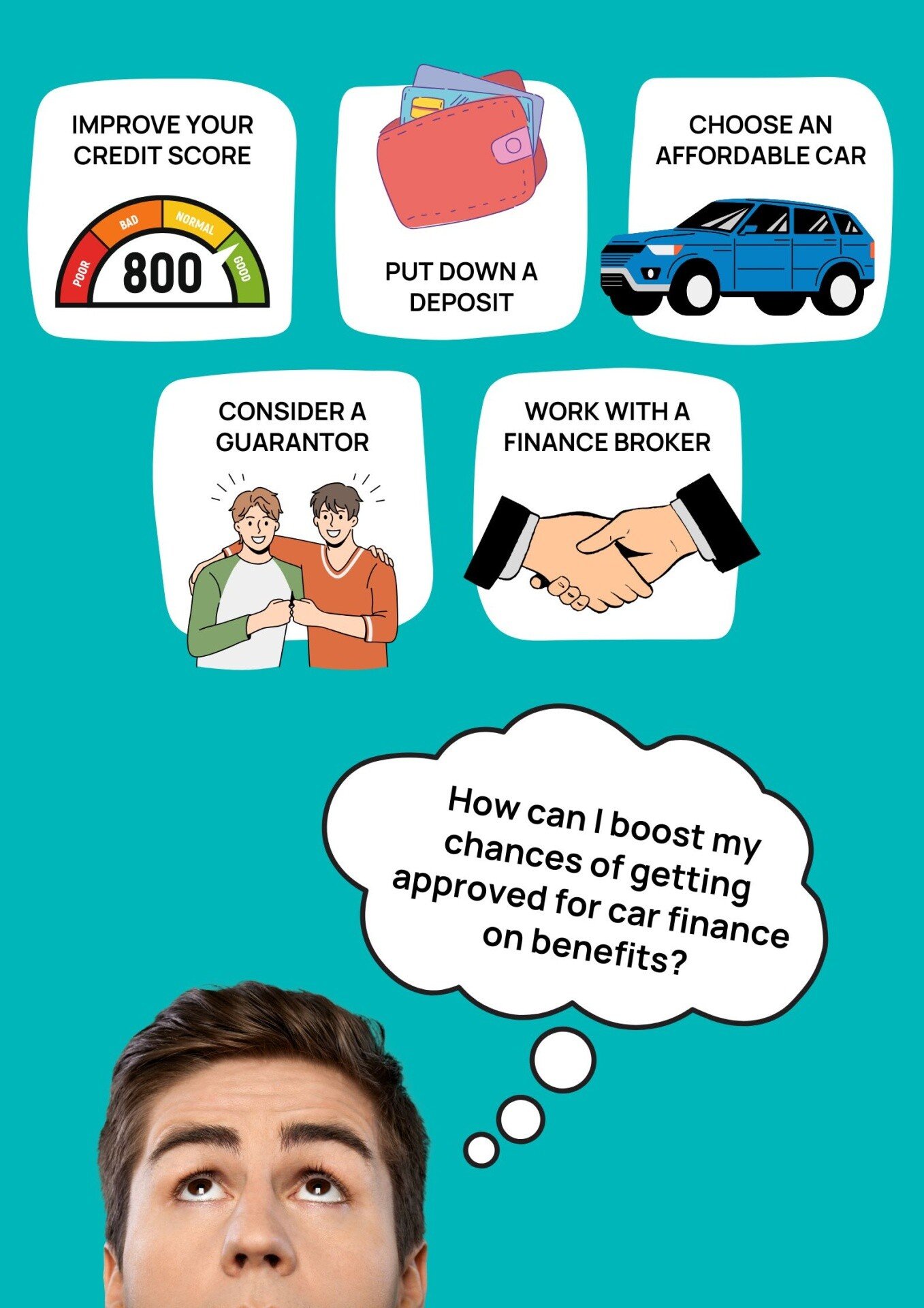
Improving your credit score is a big tick in the box for lenders. You can help by always paying your bills on time and addressing any issues on your credit report.
The chances of being approved for car finance are always greatly increased if you have a healthy deposit to put down first. This is because a larger deposit can reduce the loan amount you’ll need to borrow from the lender.
Of course, be realistic about the vehicle you’re applying to purchase. Not only do you need to choose a car that’s suitable for your needs, but it’s equally important that you opt for a car and finance plan that's affordable.
If you’re unsure about your chances of approval, then consider a guarantor. A creditworthy guarantor can strengthen your application, but you must always check that the person you put forward for this role is aware of the situation and happy to help you.
Always be transparent with the lender about your circumstances. If you receive benefits, then let them know what type and proof of any additional income sources, such as part-time work.
Working with a broker specialising in car finance can significantly increase your chances of approval. This is because they work with lenders daily and can point you to finance providers more likely to approve your application.
Frequently Asked Questions:
We hope our guide to car finance on benefits has proved to be a useful read. As an automotive broker working with leading vehicle finance lenders across the UK, we naturally get asked many questions about the topic. Below, we answer some of the most popular:
Can you get car finance on Universal Credit?
Yes, it is absolutely possible to get car finance while receiving Universal Credit (with qualifying elements such as health or caring element). As Universal Credit is a stable form of income, many lenders will consider it when assessing your application. However, you'll need to demonstrate that you can afford the monthly repayments alongside your other financial commitments.
Can I get car finance on benefits with no deposit?
While it's possible, no-deposit car finance on benefits can be challenging to obtain. Providing an upfront deposit improves your chances of approval and can result in better terms. Our guide to zero-deposit car finance explains how it works.
Can I get car finance on disability benefits?
Yes, the good news is that many lenders accept Disability Living Allowance (DLA) as a form of income for car finance applications.
Can I get car finance with PIP?
As with disability benefits, Personal Independence Payment (PIP) is often considered a valid form of income by car finance lenders.
Can I get guaranteed car finance on benefits?
Contrary to what you may have read elsewhere, there is no such thing as ‘guaranteed car finance’, as all applications are subject to assessment and review. However, there are ways to significantly improve your chances, such as working with a specialist lender who can guide you.
Can I get car finance if I'm unemployed?
It is possible, but challenging, to get approved for car finance if you’re unemployed. Firstly, you'll need to demonstrate a stable income from benefits or other sources, and you may be required to provide a guarantor for consideration.
What do I need to provide for car finance on benefits?
Typically, you'll need to provide proof of identity, address, benefit statements, bank statements, and any additional income documentation.
Access Car Finance Deals on Benefits
At Octane Finance, we understand that it can be challenging for benefit recipients to obtain car finance. We are firm believers that everyone should be treated fairly, which is why we partner with an extensive panel of trusted lenders who specialise in providing car finance solutions for individuals on benefits.
As one of the leading automotive finance brokers in the UK, with over 2,000 five-star reviews on TrustPilot, our experienced team is dedicated to helping you find the most suitable car finance option, no matter your circumstances. We work with lenders who consider various types of benefits and can often secure competitive rates and terms, even for those with less-than-perfect credit.
Contact us today to explore your car finance options and take the first step towards your new vehicle.